







Small Home Gazette, Fall 2024
A Ball to Mark Time
Each year, millions of eyes are focused on the sparkling Waterford Crystal Times Square New Year’s Eve ball. At 11:59 p.m., the ball begins its descent as voices unite to countdown the final seconds of the year.
 People stand in Times Square and sit around their televisions to watch the event. Though the technology involved in today’s celebration is a modern marvel, the New Year’s Eve ball drop is a tradition that goes back more than 115 years.
It was in 1907 that the New Year’s Eve ball made its maiden descent from the flagpole atop One Times Square. Since then, seven versions of the Ball have been designed to signal the New Year.
Before the New Year’s Eve Ball Drop
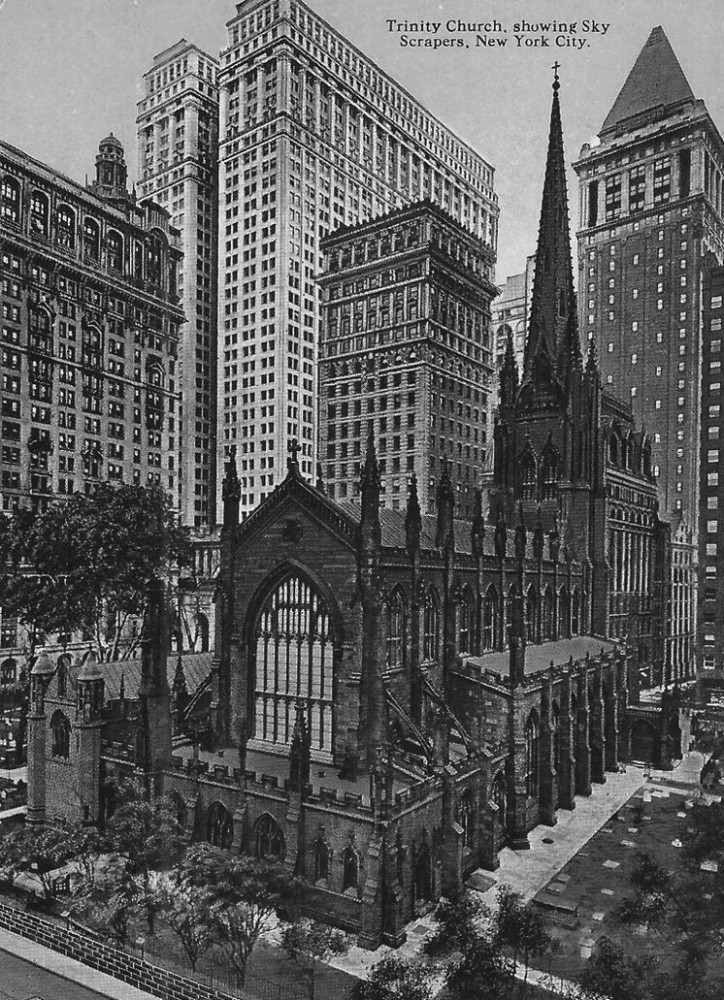
Trinity Church with surrounding skyscrapers, New York City.
Before the idea of a ball drop, celebrations of the New Year in New York City started at Trinity Church in lower Manhattan. The custom may have started as early as 1698 when the first bell was installed in Trinity’s steeple, but the first record of using bells to mark the New Year—“ringing in the New Year”—in New York City was in 1801. Crowds came to hear the then eight bells in the belfry played by James E. Ayliffe, the official bellringer. The church still has its tall and narrow steeple that forces its bells’ sounds outward rather than inwards and into the sanctuary.
The crowds grew each year (as many as 15,000 people would show up) until police officers were needed to control things in the 1890s. The tradition would be popular until the beginning of the 1900s when fireworks in Times Square gained attention.
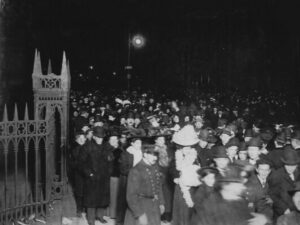
Crowd of people in church yard, 1906-07.
In his book Island of Vice: Theodore Roosevelt’s Quest to Clean Up Sin-Loving New York, Richard Zacks provides a detailed description of the celebration that ushered in 1896. “The people… waited for the famed church bells to peal in the New Year with a dozen-tune hourlong medley starting at 11:30 p.m. and climaxing with ‘Happy New Year’ at midnight,” he writes. Peddlers would sell five-cent tin trumpets, penny kazoos, Dutch watch rattles, slide whistles, and horns called “laughing hyenas.” Teenage gangs pulled petty pranks, and people freely passed around liquor bottles since public consumption of alcohol was legal. Zacks writes, “At the stroke of midnight, the world-famous chimes-man played ‘Happy New Year to Thee’ and then later added ‘Yankee Doodle Dandy’ and ‘Home, Sweet Home.’”
The Ball Drops in New York City
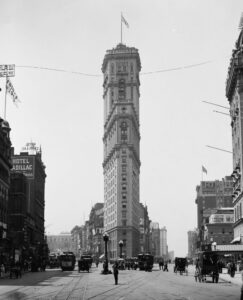
Skyscraper headquarters of The New York Times.
A New Year’s event was first organized by Adolph Ochs, owner of The New York Times. The newspaper moved into the building now called One Times Square in 1903 when the surrounding neighborhood was known as Longacre Square—renamed to Times Square in honor of the company’s big move.
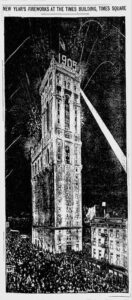
Fireworks in 1905.
To promote the new headquarters, Ochs held a New Year’s Eve event to usher in 1904. The main attraction was a fireworks show, set off from the building’s roof at midnight. This tradition continued until the celebration to welcome in 1907, when the hot ash that rained down on the city caused city officials to ban fireworks.
Ochs wanted a new way to amaze the city. He commissioned Jacob Starr, a prominent member of Artcraft Strauss (a sign design and consulting company headquartered in Manhattan), to develop a concept using the new invention of electric lightbulbs.
Jacob Starr’s Time Ball
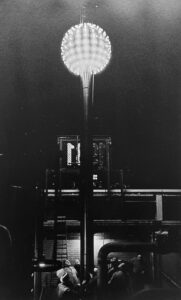
First ball drop, 1907-08.
Starr’s creation was a time ball located on the roof of One Times Square. The ball descended down a specially designed flagpole, beginning at 11:59:00 p.m. and coming to rest at midnight to signal the start of the new year.
Historically, a time ball is a time-signaling device, consisting of a large, painted wooden or metal ball that is dropped at a predetermined time, principally to enable navigators aboard ships offshore to verify the setting of their marine chronometers. Accurate timekeeping is essential to the determination of longitude at sea.
The first New Year’s Eve ball, made of iron and wood and adorned with 100 25-watt light bulbs, was five feet in diameter, and weighed 700 pounds. When the clock struck midnight, a sign that read “1908” lit up the building and spectators blew horns and rang cowbells to usher in the New Year. It must have thrilled people of the time, considering how new an invention lightbulbs were.
In 1907, the first New Year’s Eve ball was lowered by a team of six men using rope. This system was used until 1995, when the ball drop was first computerized.
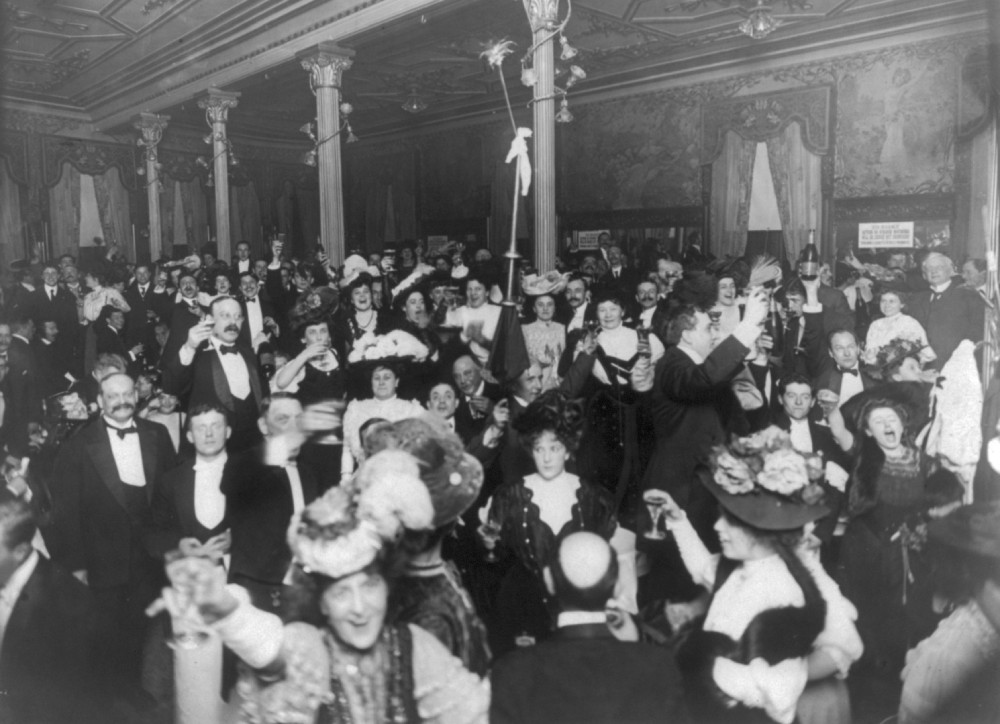
Celebration at Café Martin, New York City, December 31, 1906.
As part of the December 31, 1907 festivities, waiters in the fabled “lobster palaces” and other deluxe eateries in hotels surrounding Times Square were supplied with battery-powered top hats emblazoned with the numbers “1908” fashioned of tiny light bulbs. At the stroke of midnight, they all turned on their hat lights and the year on their foreheads lit up in conjunction with the numbers “1908” on The New York Times building.
How the Ball Changed
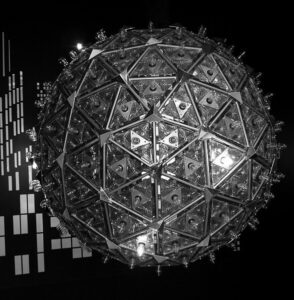
Crystal ball from New Year’s Eve, December 31, 2000.
In 1920, a 400-pound ball made entirely of wrought iron replaced the original. In 1955, the iron Ball was replaced with an aluminum ball weighing a mere 150 pounds. The current ball weighs nearly 12,000 pounds, is 12 feet in diameter, and uses over 32,000 LED lamps. Since the 1999-2000 event, the ball has featured an outer surface consisting of triangular panels manufactured by Waterford Crystal. which contain designs representing a yearly theme.
The ball has been lowered every year since 1907, with the exceptions of 1942 and 1943, when the ceremony was suspended due to the wartime dimming of lights in New York City. The crowds still gathered in Times Square in those years and greeted the New Year with a minute of silence followed by the ringing of chimes from sound trucks parked at the base of the tower—a harkening-back to the earlier celebrations at Trinity Church, where crowds would gather to “ring out the old, ring in the new.”
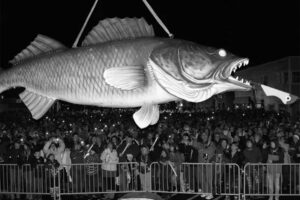
The Walleye Drop in Port Clinton, Ohio.
The Times Square ball drop has set a precedent for other versions of New Year’s Eve events around the country. Port Clinton, Ohio, is home to the Walleye Drop. For more than 20 years in Port Clinton, the “Walleye Capital of the World,” a 20-foot-long, 600-pound fiberglass walleye has been dropped at midnight. There is also the MoonPie drop in Alabama; a Guitar drop in Memphis; and the Idaho potato drop in Boise.