








Small Home Gazette, Fall 2024
Needlework Ninja
A Bungalow Club Member Weaves Beauty Into Her Home
by Tim Counts
A basic tenet of the Arts & Crafts movement, which began in England in the mid-1800s, is that handcrafted decorative objects are intrinsically superior to mass-produced, machine-made alternatives. This philosophy was first manifested in the creation of commercial goods in England, including William Morris’s famous wallpapers, and later in the U.S. in objects made and sold by craftspeople of the Roycroft colony in New York state, for example.

The bungalow owned by Robert and Deborah Smith.
Arts & Crafts advocates also encouraged homeowners to create their own domestic decorative items. This led to the wide availability of books and magazines that offered bungalow dwellers—especially women—instruction, designs and patterns with which they could craft their own items. To assist, some companies sold “halfways”—purse, pillow or table runner kits with patterns pre-printed on the included cloth. Embroidery thread was also provided so that the homeowner could complete the project herself.
Many of us who live in these bungalows today have also adorned them with handmade objects. But many—me included—do not have the interest or skills to make them ourselves. Instead, we either collect vintage pieces or buy modern versions made by living craftspeople.
Handy Household
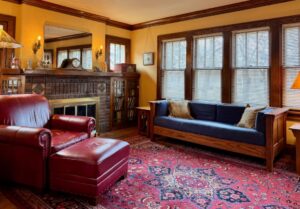
The Smith’s living room is outfitted in classic Arts & Crafts style.
There are those, however, who confidently take on home repair and maintenance as well as domestic arts themselves. Two of them are Robert and Deborah Smith, whose handsome bungalow you may have seen during the Bungalow Club’s home tour this spring.
During the 44 years Robert and Deborah have owned their home, they have accomplished an impressive list of projects and have done the vast majority of the work themselves. These included designing and finishing a new 650-square-foot bedroom suite in the bungalow’s upper expansion; designing and building a two-car garage to match the house; and creating an entirely new, vintage-style kitchen with a cantilevered bump-out to hold a refrigerator and breakfast nook. And those are just the big jobs.
Artistic Aptitude
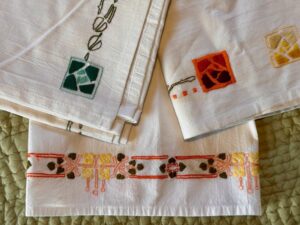 There have also been smaller undertakings, which include Deborah’s passion for creating beautiful textiles. She is an avid needleworker, having knitted throws that bear various Irish clan designs borrowed from classic “fisherman sweaters.”
Deborah is also an enthusiastic embroiderer. She has stitched Arts & Crafts patterns onto cotton muslin to create cheerful dish towels for their kitchen. But she is particularly pleased with two sofa pillows that she made from scratch. You may have seen them during this spring’s tour, resting on the Mission settle in the couple’s living room.
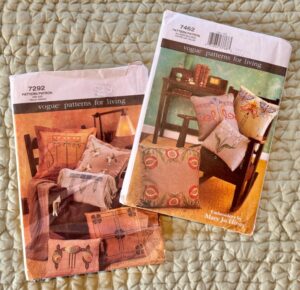
Deborah discovered Arts & Crafts pillow patterns on eBay.
While exploring eBay one day, Deborah came across two envelopes of Arts & Crafts patterns, offered by a seller in Canada. They were produced by Vogue Patterns and dated 2001. (That year, if you recall, was at the fevered height of the revival of bungalows and all things Arts & Crafts.) Deborah chose two of her favorite designs from the many included in the packets, then sourced some high-quality linen fabric at SR Harris Fabric Outlet in Brooklyn Park.
Easier Said Than Done
Collecting the materials was the easy part. The patterns included sheets of carbon paper, which were to be used to trace the design onto the fabric. Except that they did not work. For reasons unknown—perhaps the carbon paper was old, or perhaps it was because the linen had a sheen to it—the design would not transfer. Deborah finally used a red embroidery tracing pencil to draw over the designs on the tissue patterns, then ironed the pencil lines onto the fabric.
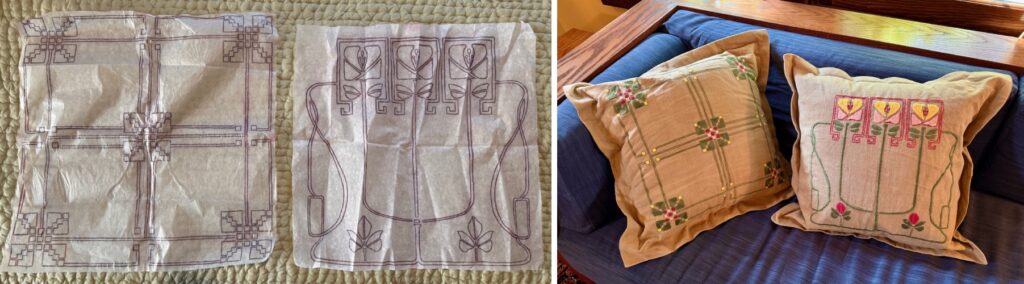
Left: Tissue patterns with designs that were transferred to the linen pillow fabric.
Right: The finished pillows.
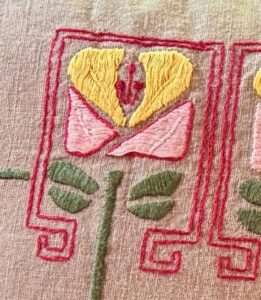 Then came the painstaking task of carrying out the embroidery itself. Deborah found that the high-quality linen she had chosen was fairly stretchy, unlike tightly-woven cottons that are often used for embroidery. She had to be vigilant about keeping the long, straight lines in the designs from going askew as she progressed.
In short, creating the designs on the fabric was a finicky chore. But one has to admit that the finished pillows are gorgeous.
Rug Renewal
Deborah’s skill with a needle goes beyond embroidery. She also tackled a project that would not occur to many of us as even possible: restoring worn areas of an antique rug.
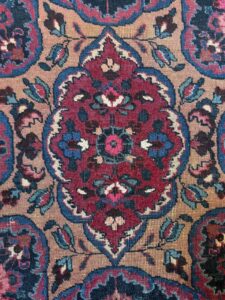
Much of the rug’s center medallion was threadbare before Deborah meticulously renewed it.
Robert and Deborah purchased a handwoven Iranian rug many years ago from a man who staged houses for real estate agents. That is, his job was to fill their empty rooms with furniture, artwork, and of course, rugs.
Deborah was smitten with the rug’s colors and pattern. “I had been looking at other rugs, but I just didn’t see anything that I liked as well.”
But the rug did have a problem common to vintage rugs. The richly colored yarns had been worn away in some areas, victim to decades of foot traffic and scooting furniture feet. The worst spot was the center medallion, much of which had been worn down to the rug’s base, which is made up of undyed warp and weft cotton threads. Robert suggested disguising the threadbare areas by coloring them with stains or dyes. But Deborah resisted. “You would know it was only painted every time you walked across it.”
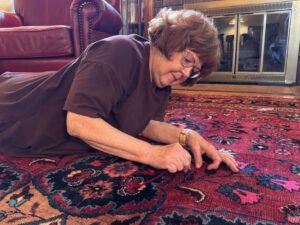 Instead, she searched the internet for rug wool and found sites that sold yarn made specifically for crewel work and rug repair. Once she had collected the proper yarn colors (which took some trial and error, as trying to asses accurate colors from a computer screen was a bit hit-and-miss), she got down to business. Literally down to business, that is, as in on her stomach and elbows on the living room floor.
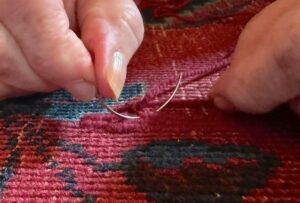
A curved needle makes stitching new yarn into the rug’s backing simple, if not fast.
Did she do research to learn how to weave new yarn to an old rug? “It never occurred to me to search online for rug repair,” she says. “I mean, it’s easy if you know how to embroider. I just use a curved needle.” The curved needle enabled her to repair the rug in place, flat on the floor. She simply stitched the new yarn into the base weave. The process was tedious, she says, but not difficult. “I just push the needle under the rug and then back out. It’s not like the rug is flopped around a lot, so nothing unravels.” Upon examining the repaired areas, everything feels tight and sturdy.
“The only thing is, it’s really, really hard to stay on your elbows for that long,” Deborah says. Does she ever use a pad under her elbows? “No,” she shrugs, “I just do it until I get tired.”
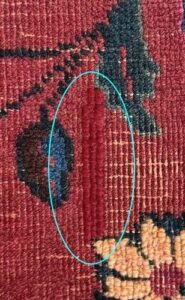
The marked area shows three rows of Deborah’s newly stitched rug yarn in an area outside the center medallion.
Deborah did not take any “before” photos of the worn areas. But she points out sections of the center medallion that she has restored, and it is clear that a sizable region has been brought vibrantly back to life. Now she is expanding beyond the center to restore areas that are not as heavily worn.
NOTE: As of this writing, one or both of the pattern envelopes that Deborah purchased online could be found at either eBay.com or Etsy.com. Search using “Vogue patterns for living” with pattern number 7292 or 7462.
Have you carried out a creative domestic project that you are especially proud of? Send a note and photographs to mail@bungalowclub.net for consideration for a story.