








Small Home Gazette, Fall 2024
No More Garage Parties
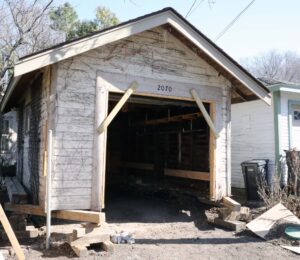
St. Paul homeowners chose to repair their single-car garage rather than build new.
St. Paul homeowners and longtime Twin Cities Bungalow Club members, Brad and Nancy Guilbeault, had tolerated the unauthorized parties in their garage for a number of years. Their garage in the western end of the Macalester-Groveland neighborhood was a popular destination. Eventually, the post-party cleanups pushed them to take action.
“The party-goers were just too destructive,” says Brad. “We could not store anything valuable in the garage, including up above on the garage’s joists.”
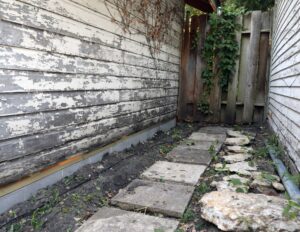
The gap between the homeowner’s garage and their neighbor’s garage does not give much opportunity for the wood to dry out. The homeowner will replace the bottom siding with rot-resistant wood.
The party guests—red squirrels and chipmunks—used any number of entrances. The side wall of the wood clapboard garage adjacent to their neighbor’s garage had rotted out after years of decomposing vegetation and rainwater coming off the roofs. The gap between the garages did not provide enough sunlight to allow the wood to dry.
Solving Many Problems
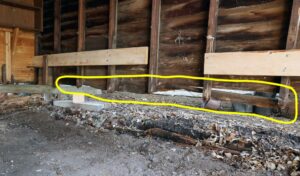
After the old foundation crumbled, years of water and decomposing vegetation had rotted away most lower wall structure.
The neighborhood rodent parties were only one of several problems. The cement pad and apron to the alley had broken into chunks that tilted every which way. The large door did not fit as tight as it once did because of the crumbling floor and subtle shifts in the structure. The wood structure was resting on the soil, and decay was advancing in several areas. One corner was still standing thanks to the metal track of the big door. During heavy rains, water flowed in under the rotting wall and settled in the middle of the floor.
Given the garage’s state of decay, knocking it down and rebuilding seemed the obvious choice—to everyone but Brad and Nancy. In their vision, the garage could remain a key addition to their property’s Arts & Crafts vibe. It just needed a little work.
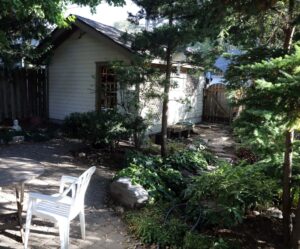
City zoning codes would require that a new garage be built closer to the center of the backyard—a move that would have ruined the mature woodland garden.
Over the years, Brad has used his finely honed carpentry skills to add artistic enhancements to their home—inside and out—building a convergence of eye-candy details and historical quality that we all aspire to create. Some of you may remember their home from the Bungalow Club’s 2016 home tour.
When pressed to explain why they chose the harder path of repairing the garage, Brad gave three reasons. First, the garage’s lightweight construction was a perfect match to their historic bungalow, which had been previously owned by Nancy’s grandfather. Second, its scale fit their small St. Paul lot, and they were happy with maintaining a single-car garage into their retirement years. Third, replacing the garage would have triggered the city’s required property line setbacks. A new garage would have to be built further from the neighbor’s garage and closer to the center of their backyard. Standing in the way was a healthy tree and their woodland garden.
Rising to the Challenge
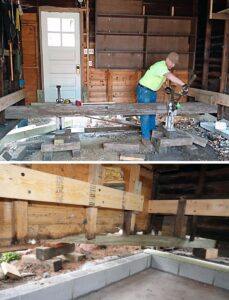
Top: A house-moving company used jacks and strong timbers to raise the garage structure off the crumbling foundation, inch by inch.
Bottom: The garage was suspended on timbers resting on piers at each corner.
Eventually, the project’s work plan became clear. The garage structure would be lifted off the remnants of the foundation and suspended on temporary piers while the old cement was removed and a new floor poured in its place. To avoid a repeat of the rotting wood at the base, a row of cement block would be laid to raise the wooden structure well above the soil line. But simply setting the garage on this new foundation would leave the doors floating inches above the ground. So, each of the wall studs had to be trimmed equal to the height of the cement blocks to ensure the doors touched the ground.
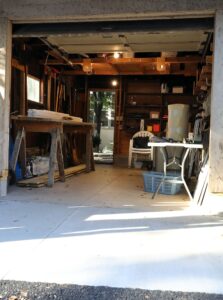
A new cement apron and floor makes the garage far more useful. For now, the homeowner has set up shop to complete the repairs before winter.
Brad and Nancy hired a house-moving company to lift the garage—a process that took only two hours thanks to the lightweight garage’s simple structure. A cement company poured the new pad in half a day and came back to set the row of cement blocks around the perimeter. Brad then trimmed the wall studs and attached a sill plate of treated lumber to join the historic structure to the new cement blocks.
Finishing Touches
With the primary work complete, Brad is looking forward to repairing and painting the big door; replacing the lowest rows of clapboards with rot-resistant wood; and replacing some of the trim and painting all of the trim.
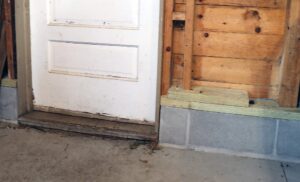
The garage’s walls and doors used to sit on a crumbling foundation. With the addition of a row of concrete blocks, each wall stud had to be trimmed so that the doors continued to reach the ground. Note the pressure-treated lumber used as a sill plate—the horizontal board that joins the wall studs to the block.
Repairing rather than replacing a garage may not be everyone’s first choice. Brad acknowledges that his skills made their project possible. For Brad and Nancy the satisfaction of preserving the structure was important. “I just could not send all that material to a landfill,” says Brad. “It was worth saving for another generation, and we are pleased with how it is turning out.”
As for the squirrels and chipmunks, they will have to party in the garden.
I went to a garden party
To reminisce with my old friends
A chance to share old memories
And play our songs again
But it’s all right now
I learned my lesson well
You see, you can’t please everyone
So you got to please yourself
—”Garden Party” lyrics by Rick Nelson
Have you taken an unusual approach to a home repair project that you are especially proud of? Send a note and photographs to mail@bungalowclub.net for consideration for a story.