








Small Home Gazette, Spring 2024
Vintage Music Company
Open a Door to Bungalow-Era Music
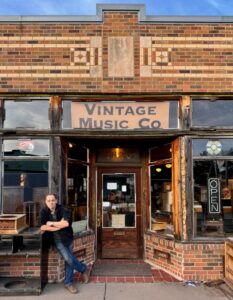
Driving through well-maintained Twin Cities bungalow neighborhoods can feel a little like time travel—a journey back to the 1910s and ‘20s. And if you step through the door of a certain brick storefront in south Minneapolis, that feeling is amplified. You will find yourself in a space filled with the music that filled our bungalows when they were new.
Welcome to the Vintage Music Company, where everything on display is from a time when phonographs were powered by hand-crank mainsprings; radios enclosed warmly glowing vacuum tubes; and records could be purchased as either discs or cylinders.
If you would like to add some aural vintage character to your home, this is the place to visit.
A Neighborhood Gem
 The Vintage Music Company is owned and operated by Scott Holthus, who started the business in 1992 in a building on Lake Street in Minneapolis, then moved to the current building in 1998. I paid a visit recently and sat down to talk with Holthus.
The first thing I notice is that he is fairly intense. “I might come off as a crank,” he says. “But I don’t mean to. I just don’t hide what’s going on with me—it’s right on the surface. Please be patient with me.” Spend a couple of minutes talking records though, and he warms right up.
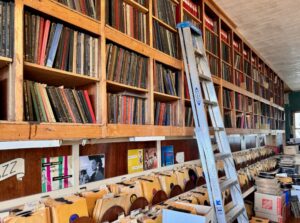
The interior of the shop is filled primarily with discs and cylinders—more than a million of them, says Holthus, though not all are in view. Many are organized in shelves that reach the ceiling and in long display racks with labeled dividers. But no sheet music.
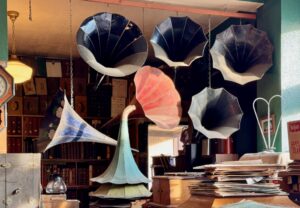
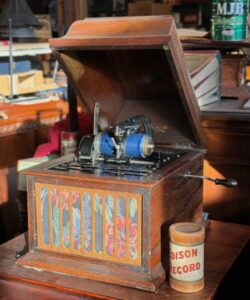 On display are hand-cranked disc and cylinder players, or “talking machines,” and hanging from the ceiling are flared speaker horns. There is also a row of vintage radios ready for restoration; a floor-standing, Art Deco radio with beautiful wood veneer; and in the street-facing display windows are consoles on legs containing record players and radios.
There are also stacks on the floor. Lots of stacks, made up of records, boxes and equipment. So many that some aisles are difficult to squeeze through.
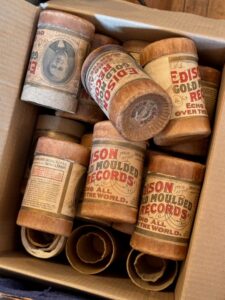 “About a year ago I ended up with a major collection after a dealer died,” Holthus explains. “There are maybe a couple thousand discs, but tens of thousands of cylinders. There are recordings that go back to the 1890s, the earliest batch I’ve ever run across.” And printed material—box after box of catalogs and flyers and other ephemera.
No wonder Holthus seems harried. His long-term goal is to sort, catalog, and then disperse each item. Some he will keep for himself; some will be sold in his shop; the most valuable will be sold online. Finally, the more common records may be given away—If you buy one of his players, he will give you a starter packet of records.
Do Not Call Them Vinyl
Speaking of records, do not call them “vinyl.” (Holthus will correct you, as he did me.) His records are made of shellac, melted and pressed into brittle discs. The heyday for 78 rpms (revolutions per minute) started in about 1914, ran through WWI into the 1920s. “That was the big sweet spot for the talking machine market,” says Holthus.
 In addition to shellac, record producers experimented with other materials during the ‘20s and ‘30s. A company called Hit of the Week distributed “Durium” records, in which a heavy brown paper base was coated with a lightweight synthetic resin. “Filmophone” records were made of flexible celluloid material and came in translucent colors. Records produced by Goodson were highly flexible discs made of an opaque white celluloid. And in 1931, RCA Victor introduced an early plastic called Vitrolac.
But records made of vinyl did not appear until 1948—long-playing (LP) discs that were designed to be played at 33⅓ rpm.
Repair and Restoration
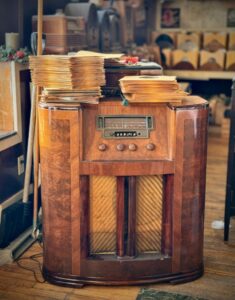 In addition to selling media and machines to play it on, Holthus will repair customers’ players. In fact, he repaired a floor-style phonograph belonging to Bungalow Club member Michael Melmer-Damon, who inherited it from his great-grandfather. The phonograph is listed as a “Treasured Item of Bungalow Club Members” on our website.
“I will repair everything from the cylinder player all the way up to tube equipment but not solid state.” He will also repair most modern turntables, as they are essentially mechanical.
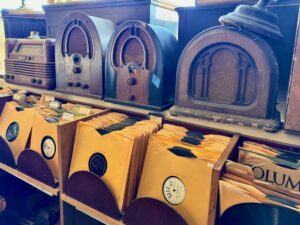 As if on cue, the shop’s door opens and a man carrying a stereo receiver steps in.
“I can’t fix that!” Holthus barks from the back of the shop. The man stops. Holthus explains what he can and can’t do; the man leaves.
I ask if that happens a lot.
“Frequently,” he says. “Sadly, people find my website when they’re looking for an electronics repair place, even though it specifically says, ‘not solid state.’ If you google for repairs, my shop will also come up for music boxes and player pianos and jukeboxes, none of which I can do. But Google’s algorithms are just…” He shrugs.
What do people come into his shop for?
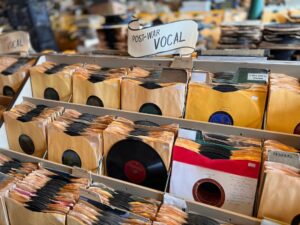 “I don’t know.” Holthus laughs. “Frankly, fully 75 percent of people who come in don’t know either. They’re just curious because this place is such an anomaly. This is the last store in the country that I’m aware of that sells just 78s. I don’t deal in vinyl at all, just 78s, not 33⅓ or 45 rpm at all. I’ll repair machines that play them—I’m not against them. But this is the music I know best.”
Finding Your Groove
Records in the shop are organized first by genre (jazz, post-war vocal, country and western, etc.), then alphabetically by artist, then by recording company, and finally by record number.
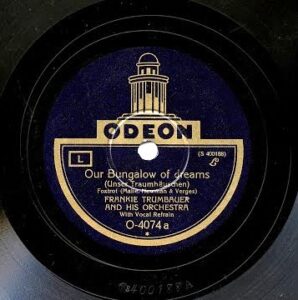
Recorded in New York on April 3, 1928; originally released on OKeh 41019.
If you are looking for something more specific, Holthus asks you to do some research. For example, an online search reveals that a song titled “Our Bungalow of Dreams” was recorded by more than one artist. A jazz fox trot version was recorded by Frankie Trumbauer and His Orchestra in 1928 for OKeh Records, disc number 41019. It was also recorded by a group called the Seven Little Polar Bears for the Cameo label, disc number 1281. Armed with this level of detail, Holthus should be able to tell you whether he has either record.
A Needle a Play
Does he have any recommendations for the care and feeding of vintage discs and cylinders?
“The needle needs to be changed every play,” Holthus insists. “If you’re talking about anything with a crank, it’s one needle, one play. That was always the rule.” Steel needles are cheap and are designed to wear down, he explains. “They are soft enough to play through the record without damaging it much. They got it down to a pretty good science, especially by the mid-‘20s.”
What about cleaning dirty or dusty records?
“There’s no point in cleaning 78s unless they’ve been sitting around a hundred years in a pile,” says Holthus. But if a record is particularly grimy, he suggests taking a dampened toothbrush with a little Dawn dish detergent and gently scrubbing in the direction of the grooves. Rinse, being careful not to get the label wet, which may cause it to come unglued or the ink to bleed.
Music to His Ears
I ask Holthus about his favorite music—genres, artists, eras?
 “All over the map,” he says. “I was raised on post-war country and western. That’s what mom and dad listened to. And late at night, mom would let me stay up with her and watch Fred Astaire and Ginger Rogers on television, those ‘30s musicals. And I love swing bands. And then the old Warner Brothers cartoons used popular tunes of the day. I love classical and opera and country and there’s even some hip-hop that I’m rather fond of.”
I ask Holthus what recordings he might suggest for someone interested in exploring music from the bungalow era. He resists, saying that there are too many that have equal footing for him to recommend. But when pressed, he volunteers a few options:
- “I Love Me,” a comedy song by Billy Murray, recorded in 1923
- “Gonna Meet My Sweetie Now,” by Jean GoldKette and His Orchestra, is a jazz fox trot recorded in 1927
- “West End Blues” by Louis Armstrong
- A comedy routine by Nat Wills, “No News, or What Killed the Dog,” from about 1910
- Anything by Bix Beiderbecke, a jazz trumpet player from the late 1920s
- Anything by the Duke Ellington band in the late 1920s
- Songs by Annette Hanshaw, one of the most popular radio stars of the late 1920s and early ‘30s
- Music by Ruth Edding, who was known as “America’s sweetheart of song” in the late 1920s and early ‘30s
- Musical comedy routines by Gallagher and Shean from the 1910s and ‘20s
Resources
 Vintage Music Company
1820 East 38th St., Minneapolis
Wednesday through Saturday, 11 a.m. to 6 p.m.
612-729-8929
vintagemusiccompany.com
For further reading:
“History of the Record Industry, 1877-1920s”