








Small Home Gazette, Summer 2024
Creative Solutions: Fighting Window Condensation
On a cold winter’s night, does condensation on your windows cause you concern? Do you attack it with paper towels or a sponge, only to have the moisture return? Many of us have seen the impact of repeated window condensation first-hand. Do we have to accept, and constantly address, failing paint or varnish, discolored wood, and mold? New, multi-pane windows are not the answer, as manufacturers tell us that some window condensation is normal.
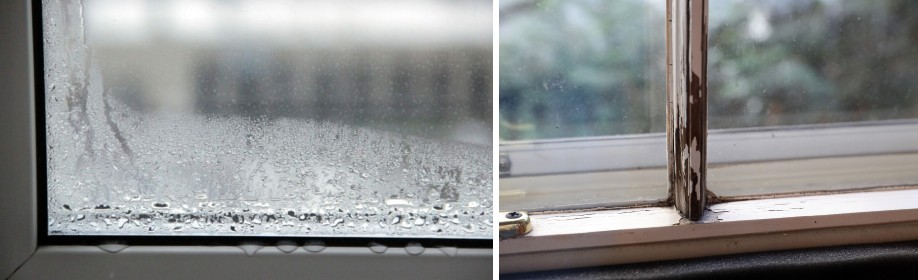
Water condensation and the resulting mold and paint and varnish failure are common issues in homes.
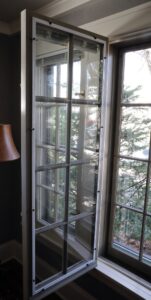
Note the extra glass, framed in white, covering nearly the entire surface of this window.
One St. Paul homeowner is testing a solution to this age-old problem of seemingly unavoidable window condensation. His approach is simple: attach another piece of glass over his interior windows to trap air between the panes. His example is on casement windows, but it might work on double-hung window, which are more common in Twin Cities bungalows.
Top: The metal rail, with weatherstripping installed, arrives in various lengths. Middle: Inside the metal rail is a rubber gasket that holds the edge of the glass. Note the narrow tuft of weatherstripping on the side that goes against the window frame. Also, a metal L-shaped bracket inserts into the rails to hold the corners of the frame tight together. Bottom: The new pane of glass, framed in metal, is secured to the window using metal clips.
He begins by cutting small, metal rails to create a frame around the new pane of glass. The rails have a built-in strip of insulation to create a tight seal when the new window is attached with metal clips. Also, a metal L-shaped bracket inserts into the rails to hold the corners of the frame tight together.
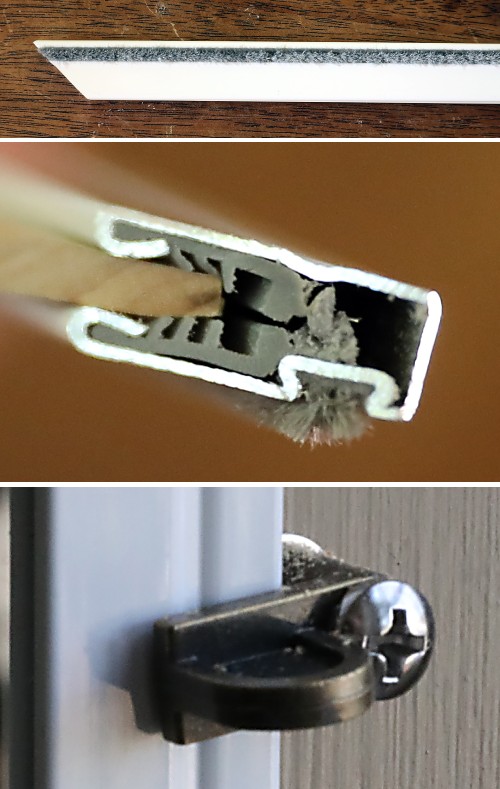
Top: The metal rail, with weatherstripping installed, arrives in various lengths.
Middle: Inside the metal rail is a rubber gasket that holds the edge of the glass. Note the narrow tuft of weatherstripping on the side that goes against the window frame. Also, a metal L-shaped bracket inserts into the rails to hold the corners of the frame tight together.
Bottom: The new pane of glass, framed in metal, is secured to the window using metal clips.
The new glass can go on either side of the inside window. You can choose based on aesthetics. If your windows are the vintage, single-pane variety, this gives you two panes of glass plus your storm window between your warm interior and the cold outside world.
As we noted earlier, this idea works very well on casement windows that open from the side. For double-hung windows, the upper and lower sashes slide too close together to insert another pane of glass. So, you can only insert the extra glass on the outside of the upper sash. For the lower sash, you can only place the extra glass on the inside surface. As a result, your window blinds may not get past the extra thickness of the new pane of glass on the lower sash, and window handles might have to be moved lower on the sash to accommodate the new glass frame.
If you are good at taking precise measurements and carefully cutting thin metal rails, this can be a DIY project for you. Otherwise, you will need to find a handyperson with these skills.
Resources
Metal Rails
DK Hardware Supply sells the metal rails, called a universal sash storm window frame, in various lengths in white, dark bronze and a dull silver. Be sure to purchase extra to compensate for any mistakes you might make in measuring and cutting.
Glass and Metal Clips
Our handy homeowner recommends 1/8-inch-thick window glass, which can be ordered at any local home improvement store. The metal clips and screws for mounting the new pane of glass are also easily found.
Other Examples?
If you know of other creative solutions to make bungalows more livable, send them to us at mail@bungalowclub.net. Whether they save space; provide modern convenience with an historically-appropriate appearance; or simply make the best of a difficult situation, we would love to share them in the Small Home Gazette.