








Small Home Gazette, Summer 2024
Sleeping Porches—From Elegant to Odd
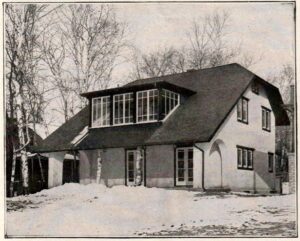
A prominent sleeping porch on a “semi-bungalow” featured in the November 1913 issue of Keith’s Magazine, published in Minneapolis.
In the early 20th century, breathing fresh, outdoor air while sleeping was considered a necessity for healthful living. Fresh air was believed to keep myriad diseases—including tuberculosis—at bay, and if such diseases were contracted, sleeping in outdoor air was often prescribed as a treatment.
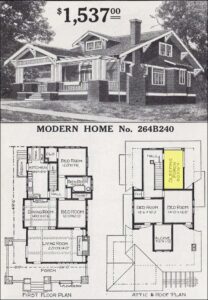
A page from a Sears & Roebuck kit house catalog. Note the sleeping porch included in the upper level floorplan, in the back right corner.
Today, it is difficult to imagine how prevalent this concept was. Sure, it may be nice to leave a bedroom window open if there is a breeze and city noise is not too intrusive. But some days, outdoor air is downright unhealthy (especially when Canada is on fire), and medical science has given us far better remedies for what ails us. In addition, modern air conditioning has tempered the need to seek out cool nighttime air.
But those of us in old houses often live with structural remnants of a different way of life, and porches that were once used for sleep may be more common than you think. Below is an overview of some typical sleeping porch configurations, as well as some that are definitely unusual.
In addition to this text, I encourage you to read a brief online article titled “Hygiene and housing: the sleeping porch in Minnesota”. Written by author and local historian Mary Krugerud for Hennepin History magazine, it is an excellent overview of the medical beliefs that led to the addition of many of the sleeping porches on homes throughout Minnesota.
Part of the Plan
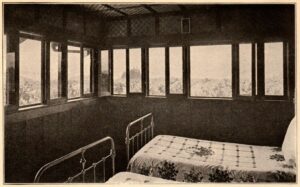
Smaller bungalows lack space for a dedicated sleeping porch such as this one.
A significant number of houses built in the Twin Cities during the first three decades of the last century included sleeping porches. It is impossible now to determine an exact percentage, but once you know what to look for, they are fairly easy to spot as you pass through vintage neighborhoods.
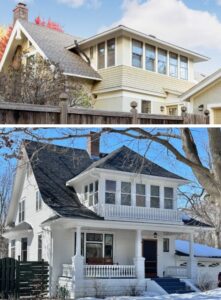
The Bungalow Club’s 2023 home tour included two sleeping porches: one on the back of the first tour house in St. Paul (top); and one on the front of the house in Maplewood.
That said, most of our modest bungalows (including mine) do not include a sleeping porch. Limited square footage did not allow such a luxury; an open bedroom window or two had to suffice. But larger houses, especially those with a partial or full second floor, often included a sleeping porch, or a sun porch that doubled as a place to sleep. If you attended the Bungalow Club’s 2023 spring home tour, you would have seen a sleeping porch at the back of the starting home’s second floor and another on the front of the home in Maplewood.
During the early 20th century, domestically-themed magazines often included articles on sleeping porches. If the featured home was generously-sized, such porches were large and outfitted with fashionable furniture, fabrics and curtains. They might have included a daybed, dressed with a decorative throw and colorful pillows during the day and remade with sheets and a feather pillow at night.
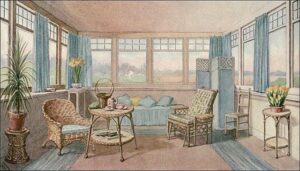
A tastefully furnished sunroom/sleeping porch. Note the daybed against the back wall, under the windows. Image is from a 1911 issue of The Ladies Home Journal.
One article illustrated a particularly clever (and rather gimmicky) approach: A sunroom by day, with a bed that descended from the ceiling on cables for slumber. I recall that, many years ago, a house on the Minneapolis-St. Paul Home Tour had such a bed in the ceiling of its screened porch, still intact.
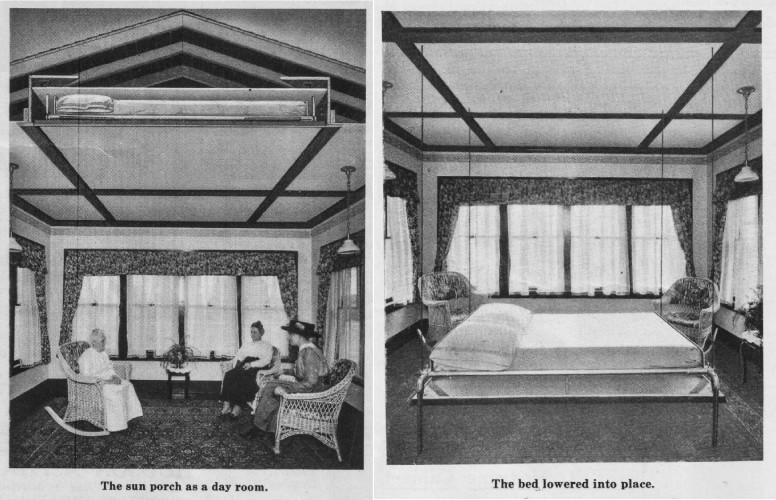
In the left image, note the retracted bed visible in the ceiling’s cutaway section. Images are from the July 1916 issue of Keith’s Magazine.
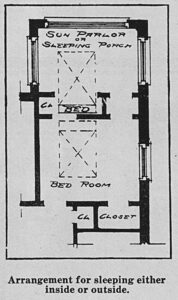
In this scheme, a fold-up bed could be pivoted inside a closet and lowered into either the enclosed bedroom or the sun parlor/sleeping porch.
Cold Comfort
Current-day recommendations for restful sleep often include maintaining a cool temperature in the bedroom. But during the bungalow era, directives for healthful sleeping also included doing so in bitterly cold weather. A 1923 publication titled The Home suggested outfitting sleeping porches with rolled canvas curtains to keep out rain and snow.
“The curtains may be lowered down on the windward side and fastened securely in place. With the direct force of the wind thus eliminated and an adequate supply of bed clothes, the porch is a sleeping place comfortable even when the temperature is far below freezing.”
The article also advocated “…night clothing designed for outdoor wear.” The description of the outfit creates a comical mental image.
“Flannel pajamas provided either with enclosed feet or with bed socks that can be tied at the ankles will keep the feet comfortable in the severest weather. On the coldest nights a hood of the same pattern used by aviators may be slipped over the head and tied around the neck.”
Thinking Outside the Box
Even if an early 20th century home was too compact for a large room devoted exclusively to a sleeping porch, innovative architects and homeowners came up with methods to ensure some fresh overnight air.
One designer created a flexible bedroom/sun parlor/sleeping porch. The space was outfitted with a pivoting bed that folded upright inside a closet. The closet opened on one side to a snug bedroom in the home’s interior, and on the opposite side, to a small porch with windows on three walls.
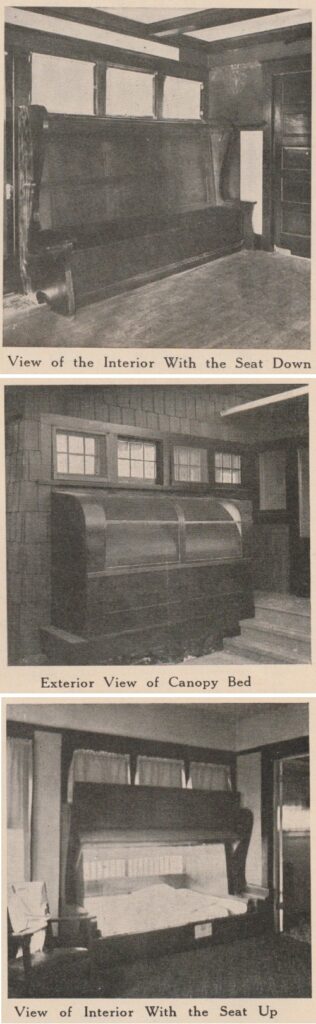
An even odder contraption was promoted in the November 1913 issue of Bungalow Magazine. Dubbed “Outdoor Bed With a Swinging Canopy,” the writer enthused that it “…costs little to construct and takes up far less space than a sleeping porch. It is likely to prove very popular.”
Inside the house, the device appears to be a long, built-in hall bench during the day. At night, the seat and back can be raised, revealing an opening in the exterior wall with a bed mattress positioned lengthwise, half inside and half outside. On the home’s exterior is a bump-out built to support half of the mattress, plus an arched, screened structure above it. To complete the functionality, the rig included a curved, metal canopy inside the screened portion to protect the bed from the elements when it was unoccupied. Or, when an occupant was in the bed, the canopy could be pivoted to the home’s inside, covering the opening in the wall and isolating the sleeper in the screened area outside.
The design is certainly ingenious, though I doubt that it became as popular as the writer believed it would.
Kids in Cages
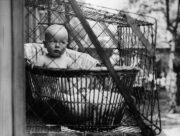 Finally, we go from merely odd sleeping porches to the downright weird—and by today’s sensibilities, even alarming: the baby cage.
According to Wikipedia, the baby cage was intended to give babies whose families lived in city apartments access to fresh air and sunshine. In fact, Eleanor Roosevelt used one for her first daughter, Anna. Parents might not have left their infants in the cages overnight, but babies certainly would have at least napped there.
According to Wikipedia, the cages gained wide popularity in London in the 1930s, at least until air raids at the start of WWII ended their use.

Echoes of Porches Past
How would you know today whether a room in an old house started life as a sleeping porch?
The most obvious clue would be the number of windows. Sleeping porches had a lot of them, so as to optimize fresh air enveloping the sleeper. They would have had rows of windows on at least two walls, often three. Windows might have been constructed more simply than the sturdy, double-hung sash type, and certainly there would have been no storm windows. Screens would have been a must, however. In addition, some sleeping porches were built of simpler construction than the rest of the house, as there was no point in isolating indoor from outdoor temperatures. Walls might have been a single layer with no insulation, lacking interior lath and plaster finish.
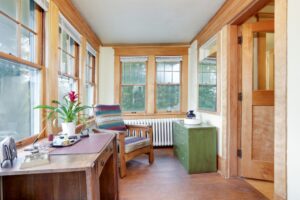 On the other hand, some sleeping porches also doubled as sun rooms during the day and therefore, would have been built using the same construction methods as the rest of the house.
Today, it is safe to say that virtually all porches that were built primarily for sleeping are no longer used for that function, and that they likely have been fortified. Walls might now be insulated and finished to match the rest of the house. Weathertight windows would have been installed. Auxiliary heating and air conditioning mechanicals may have been introduced.
But if you look closely and use a little imagination, you just might be able to perceive a porch from the past.