








Small Home Gazette, Winter 2024
Bring On the Chill
Approaches to Cooling a 1912 Home
This time of year, seeking out a cool breeze may not be your top priority. But summer is inevitable, and if your home lacks air conditioning, it may be easy for you to summon memories of sweltering summer days.
Air Options
There are several possibilities for adding machine-chilled air to a home. If you live in a Twin Cities bungalow with most or all of the living space on the main floor and your basement is unfinished, adding central air conditioning is relatively simple, especially if you already have ductwork in place for forced air heat.
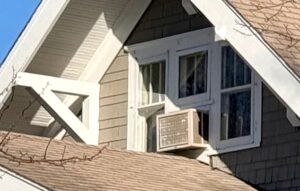 For homes without ductwork, window air conditioning units are a simple solution. They can be installed in practically any room; can be removed and stored during cool months; and are inexpensive when compared to more integrated solutions. But they are inarguably ugly, especially if the windows best suited for an air conditioner inside the house are facing a public street. They can also be quite noisy; and installing and removing them with the seasons is a drag.
A related style, portable indoor air conditioners, are essentially window units on wheels, with a flexible duct that must be vented out a nearby window. But they are bulky, noisy, and do not cool as effectively as window units.
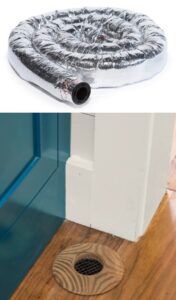
Top: Flexible ducts can be installed in tight places. Bottom: High-velocity outlet vents are inconspicuous.
Then there are whole-house, high-velocity systems. You likely have seen ads in old-house magazines for the primary manufacturer of this technology, Unico Systems.
Instead of boxy ductwork built into rectangular cavities, a high-velocity system delivers cooled or heated air via flexible, typically 2-inch diameter tubes encased in insulation. The tubes are slender enough to be snaked through walls, ceilings and floors, even walls that are constructed with 2-by-4-inch studs. Instead of using traditional rectangular grate vents, high-velocity outlets are discrete round openings.
A downside of high-velocity systems is cost. Installation typically runs between 50 and 100 percent more than a traditional ductwork heating and cooling system, primarily because of the labor and expertise required to thread the tubes through tight spaces. But the systems are far more efficient than box ducts, and the added costs are eventually recovered through energy savings.
Mini-Splits
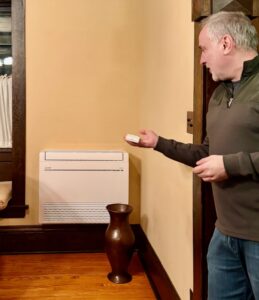
Homeowner John Piccone holds a remote for his home’s ductless mini-split system. The unit on the wall provides cooled air for his living and dining rooms and is rated for 12,000 BTUs (British Thermal Units) of cooling power.
An increasingly popular fifth option is a ductless mini-split system. If your vintage house does not have ductwork and is heated by hot water or steam radiators, mini-splits may be a good option.
These systems have no ducts at all. All its components are exposed and visible, including an outdoor compressor and one or more indoor evaporators. The components are connected by electrical wiring and tubing that is attached to the exterior of the house. Wires and tubes for each evaporator enter the home through a 3-to-5-inch hole drilled through an exterior wall.
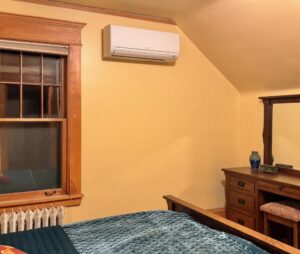
One of two mini-split units installed in Piccone’s upstairs bedrooms. Each is rated for 6,000 BTUs.
Inside, conditioned air is produced only at the wall-mounted evaporators rather than funneled via ductwork to air vents throughout the home. This generally limits the placement of the system to both sides of a single exterior wall.
Since mini-splits use heat pump technology, the same equipment can also heat a home—to a point. In short, they cool by absorbing warm air inside the home, then release the warmth outside. In cold weather, they absorb heat from outside air (yes, even in below-freezing weather) and release it inside. The colder the outside air, the less heat they are able to deliver inside. For a good explanation on heat pumps by the guys at This Old House, see the link at the end of this article.
A Recent Mini-Split Installation
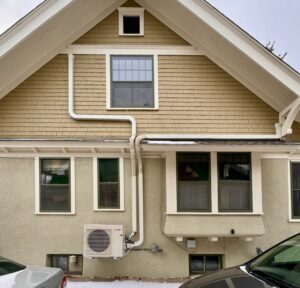
The mini-split heat pump system’s exterior compressor unit (mounted on the wall a couple of feet off the ground) is capable of generating 36,000 BTUs of cooling energy. From the compressor, conduits enclosing pipes and electrical wires snake to the upper floor. At each conduit’s end is a hole, through which wires and pipes enter the house and connect to evaporation units on interior walls.
If you attended the spring 2023 Bungalow Club home tour, you visited the home pictured on these pages. It is owned by John Piccone, who moved to St. Paul in 2021. When he purchased the 1912 story-and-a-half home (a configuration often referred to during the early 20th century as a “semi-bungalow”), it had hot water radiator heat and no air conditioning.
Later in the summer, Piccone got bids on mini-split systems. He chose an offer submitted by Standard Heating & Air Conditioning. The entire cost, including equipment and labor, was just over $17,000. Another bid, around $25,000, was from an installer who suggested using floor vents on the main level, installed over evaporator units mounted between joists in the basement. This method would have had the advantage of moving the evaporator off the wall and out of sight. But Piccone opted for Standard Heating’s lower-cost, wall-mounted system. Besides the additional cost, he says, “I didn’t want to cut holes in the floors.”
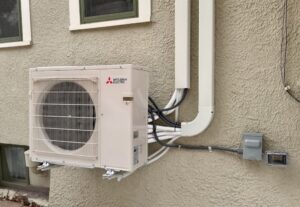
The mini-split heat pump system’s exterior condenser unit, capable of generating 36,000 BTUs of cooling energy.
The system designed by Standard Heating includes an outdoor compressor that is linked to three indoor evaporator units: one large unit for cooling the public rooms on main floor and two smaller units, each mounted in upper-level bedrooms. About one-third of the compressor’s capacity is currently not being used. Piccone plans to remodel the 1970s-era kitchen positioned at the back of the home’s main level, which will then need a fourth evaporator unit. How well does it work? “Very well,” says Piccone.
The main-level unit must cool a large area, which includes the home’s 27-foot-long living room and the adjoining formal dining room. Piccone says it does an adequate job, as those rooms face north and are somewhat insulated from the intense southern sun by the rest of the house. The two upstairs units cool the second floor comfortably. The units are very quiet, emitting only a whisper of white noise. “It’s actually helpful for sleeping,” says Piccone.
The entire process, from contacting Standard Heating & Air Conditioning to installation, took about two weeks. The actual installation of the system was completed in just one day.
“It probably would have been faster if I hadn’t done it in the depth of summer during a heat wave,” he says.
Admittedly, the off-white plastic component casings are visually at odds with the vintage elements of Piccone’s home. Steps could be taken to reduce their visual impact, such as painting them to blend with their surroundings. Mitsubishi, the manufacturer of the system, recommends Krylon Fusion brand spray paint, which is formulated to adhere to plastic, indoors and out. (It would be smart to ask your contractor about this during the bidding process.)

The external components of the mini-split system are mounted on a wall that faces a neighbor’s driveway, minimizing their visibility from the street.
To reduce the visual impact of the external components, they were installed on a wall that faces the neighbor’s house, about 16 feet away. That space is occupied by a driveway where cars are usually parked.
In the end, choosing a mini-split system means that you will just need to accept the presence of modern elements in your vintage interior, much like a television or speakers for a music system.
A Century Without Air Conditioning
How did John Piccone’s two-story, three-bedroom home in an affluent neighborhood manage to exist 111 years without being retrofitted with an integrated air conditioning system? The home’s previous owner was able to explain.
Piccone bought the home from Bungalow Club member Bruce Almquist, who lived there for 30 years with his wife and their two children. Says Almquist, “We never really considered installing whole house air conditioning because it never got so hot we thought it was necessary.”
They used a combination of fans; a single window air conditioner; and open windows to keep the house comfortable in summer.
First, explains Almquist, he would open the hatch to the attic, located in the closet ceiling of the smallest bedroom. He laid a box fan on its back over the opening and kept it running on low, day and night. The family opened a few north- and east-facing windows, which did not get direct sun, on the first and second floor. The fan gently pulled air up through the house and into the attic, where roof and gable-end vents released heat to the outdoors.
“This dropped the temperature in the whole house a bit,” says Almquist.
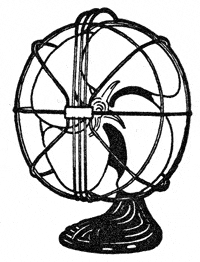 The air convection was combined with a single window air conditioning unit, which, over the years, was moved among various second-floor windows (though for aesthetic reasons, never facing the street). Almquist and his wife never installed it in their own bedroom because of the noise. “But we did have a 1930s Zephyr oscillating fan,” he remembers. “It had a wonderful hum to it.”
The combination of cooling methods kept the house comfortable enough for the family. “The roof has fairly wide overhangs,” adds Almquist. “In the middle of the summer when the sun was high, they kept it from blasting in the windows.”
The first floor stayed cool enough, and they spent a lot of evenings relaxing on the north-facing, full-width front porch.
Hotter and Wetter
Though to outsiders, Minnesota has long had a firmly-held reputation for harsh winters and mild summers, that perception may be thawing, so to speak. According to the University of Minnesota’s Climate Adaptation Partnership, our average annual temperature has increased by 3 degrees Fahrenheit since the late 1800s. And the trend will continue. That likely means that the number of vintage homes without refrigerated cooling will continue to dwindle.
Resources
Online articles:
- “High Velocity Air Conditioner—Everything to Know”
Shrink That Footprint - “How a Heat Pump Works”
This Old House (YouTube) - “No Ducts? Here Are Five Air Conditioning Options for Older Homes Without Ductwork”
Cielo - “Your All-in-One Ductless Mini-Split Heat Pump Guide for 2024”
Cielo