







Small Home Gazette, Winter 2024
Stop That Tickle!
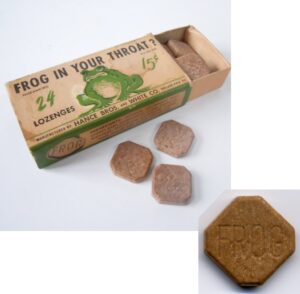
One of several early box designs. Note the word “FROG” imprinted on each lozenge.
In the early 1900s as well as today, seasonal allergies or colds could trigger an irritated voice. Sometimes people with raspy or husky voices are said to have a frog in their throat—an old English expression that carried over into daily use in America, probably surviving from the language of early settlers. (The expression may originally have come from a medieval belief that secretions from a frog could cure sore throats.)
So, why not name a throat lozenge after the expression? Hance Brothers and White, pharmaceutical chemists in Philadelphia, Pennsylvania, did just that. In December 1894, they introduced a throat lozenge called “Frog in Your Throat?“ to a national audience.
 The front of a box of 24 lozenges depicted a rather sad-sack, fat frog with the product name and sometimes the phrase “The Greatest Throat and Voice Lozenge on Earth” And on the back of the box, the lozenges were touted as “…useful in Coughs, Colds, Hoarseness, Laryngeal and Bronchial Inflammation, Rawness, Irritation, Tickling, Clergymen’s Sore Throat, Smoker’s Sore Throat, Soreness resulting from dryness of the throat and air passages, or from clearing the throat…Especially useful to Singers, Speakers, Readers, Actors, Teachers, and all voice workers.”
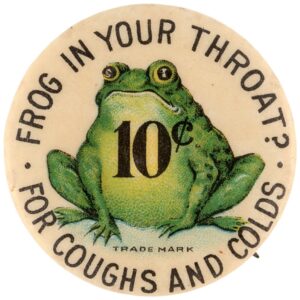 The items created to advertise this product were quite interesting, consisting of medicine cards, postcards, match safes, fishing lures, buttons, cardboard display ads and more. The frog image was memorable, quirky and versatile.
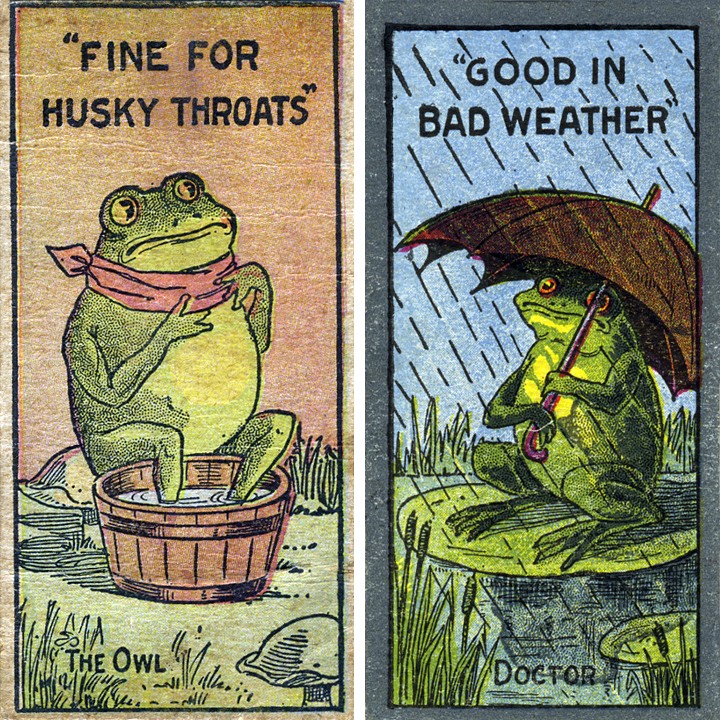
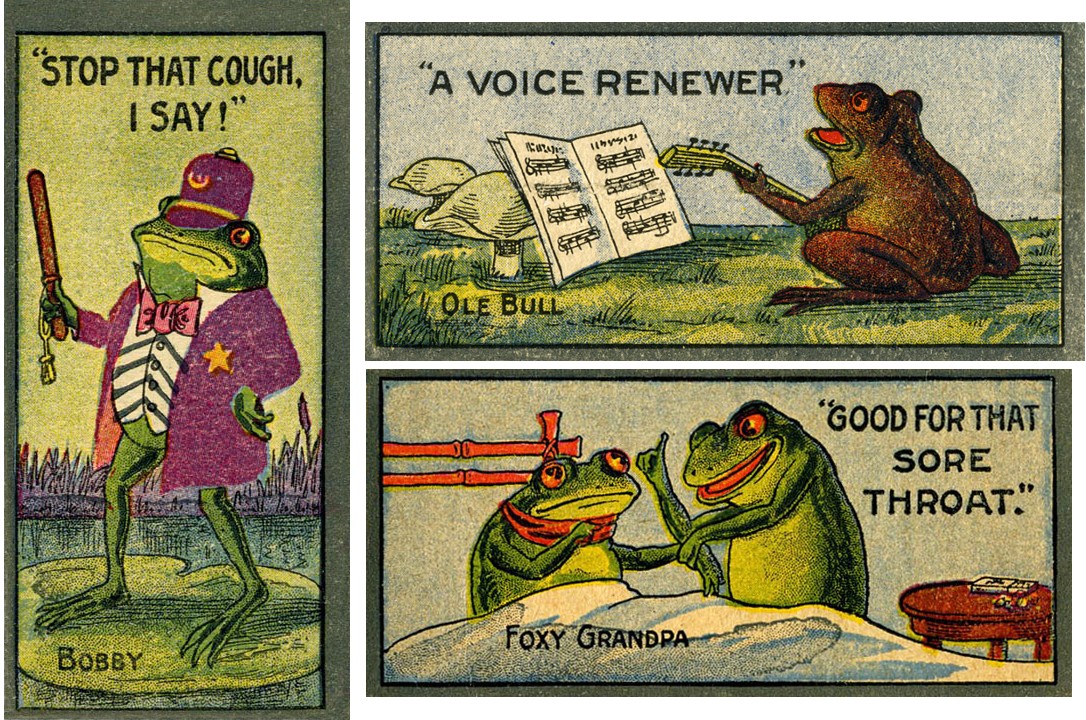
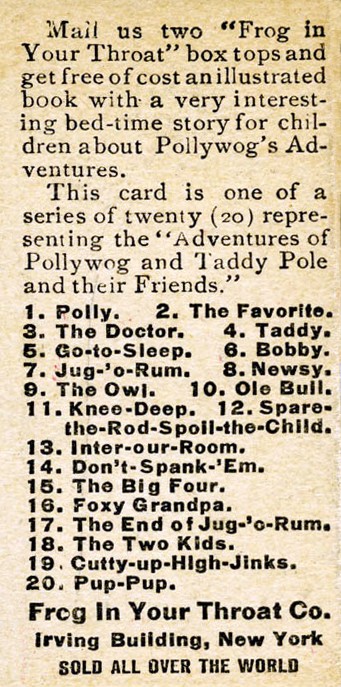
One set of 20 medicine cards, or trade cards, depicted the frog as a character in a scene where taking the lozenge would be helpful. Each frog character had a name such as “Doctor” or “The Owl.” Usually free at apothecary shops, people collected the cards for scrapbooking or one could mail them in to get a free children’s book about the adventures of a polliwog.
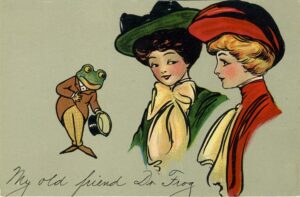
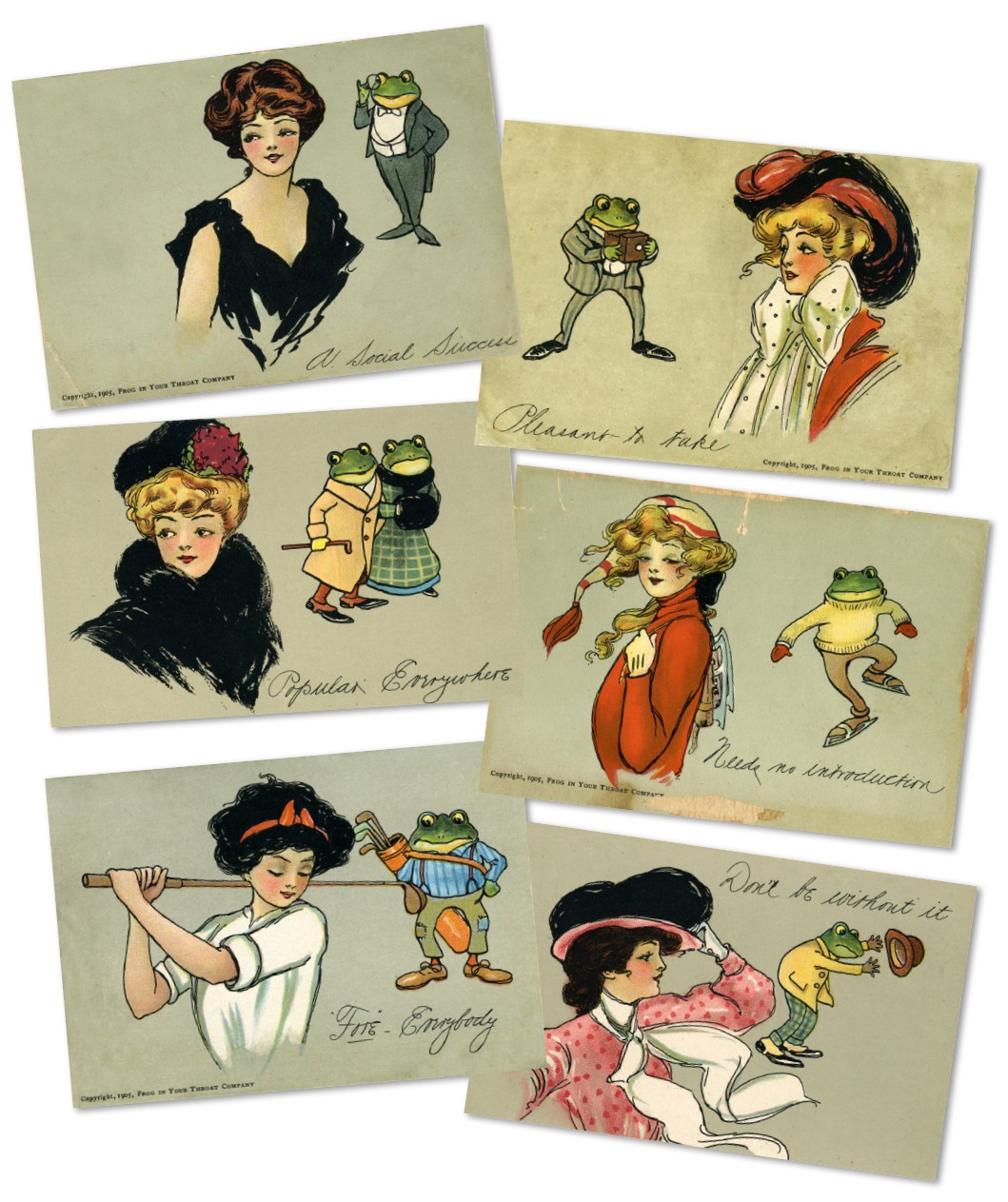
A set of postcards, dated 1905, numbered 12 in total. The frog was shown interacting in a rakish manner with fashionable ladies, and there was a clever little saying printed on each. Cheap to mail, postcards were extremely popular in the early 1900s. An effortless way to communicate with friends and family, they were also a way to share interesting graphics and messages—and to promote products. See six more postcards at the end of this article.
Apothecary windows selling the product—both in the U.S. and later in England where it was also popular—were known to be filled with frogs: big and little, standing, sitting, walking, jumping. The windows were described in newspapers as “one of the best and most extraordinary window displays” and “one of the latest developments of Yankee advertising.” Of course, the frogs were no longer alive.
If a voice you hear sounds hoarse or croaky, just think of the image of a “frog in your throat.” Ribbit! Ribbit!
Additional Medicine Cards and Postcards
The three medicine, or trade cards, below are part of a set of 20.
The back side of a card explained how to mail in a set to get a children’s book.
The postcards below are part of a 1905 set.